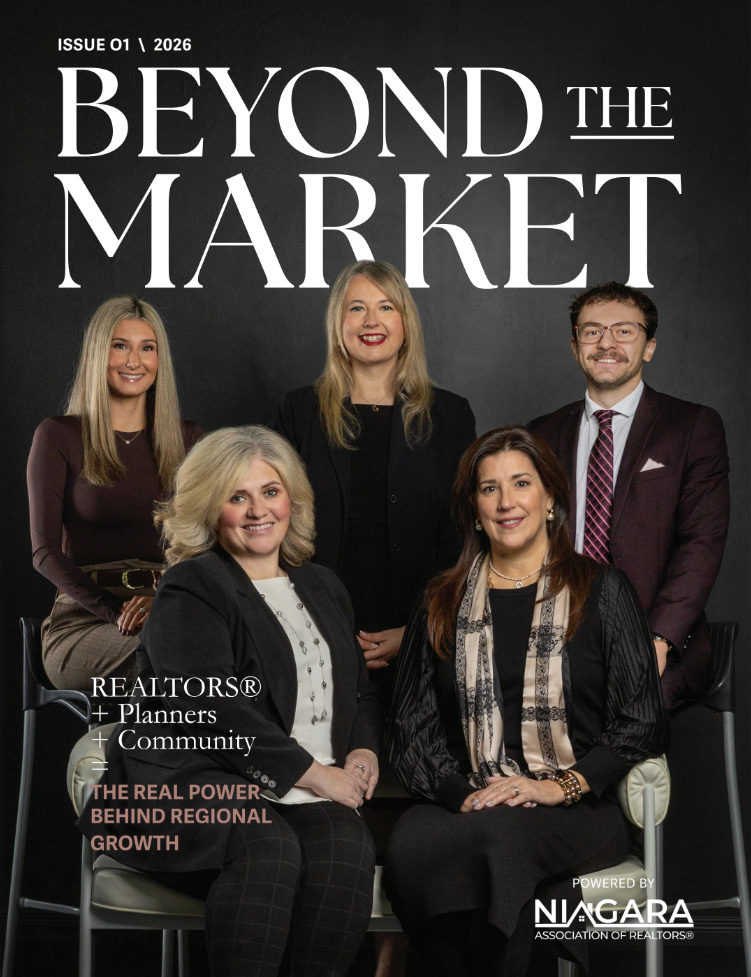
One Region, Twelve Municipalities: Who Shapes Niagara?
A Conversation with Diana Vasu of Nethery Planning
Target time: 40–44 minutes
Central tension: Planning authority may be local, but its consequences cross municipal boundaries.
0:00–3:30 | Opening Setup
HOST:
Niagara is often discussed as one place, but it is composed of twelve municipalities—each with different economies, communities, landscapes and development pressures.
What works for an urban centre may not suit a rural township. A housing decision in one municipality can affect transportation, infrastructure, employment and affordability elsewhere.
Planning may appear technical, but its consequences are personal. It determines where homes and businesses are built, how communities grow, what infrastructure costs and which lands are protected.
Today, we’re examining how Niagara can grow as twelve municipalities without losing sight of one shared regional future.
Diana, welcome to Beyond the Market.
[Shake hands and allow a brief greeting.]
Opening Banter
HOST:
Diana, your bio says good planning can save the world. Still confident?
Optional follow-up:
Which planning problem would you solve first?
[Allow the conversation to develop naturally.]
Guest Introduction
HOST:
Now, let me properly introduce you.
Diana Vasu is a planner with Nethery Planning whose background combines municipal experience, public policy and communication. She has worked in municipal planning and administration, is pursuing a Master of Science in Rural Planning and Development from the University of Guelph, and holds bachelor’s and master’s degrees in English from Brock University.
That combination gives Diana a valuable perspective on a profession where language can determine whether people understand a proposal, participate effectively or feel excluded from the process.
Today, we’ll move beyond the jargon to discuss property decisions, neighbourhood change, public participation and how Niagara’s twelve municipalities can plan for a shared future.
3:30–8:30 | Diana’s Path into Planning
HOST TRANSITION:
Before we examine the system, may I ask,
1. How did an English background lead you into land-use planning?
2. What does writing teach planners that technical education sometimes misses?
3. Can clearer language produce better planning decisions?
Optional follow-up:
Can confusing language unintentionally exclude the public?
4. Where does a planner’s influence end and political authority begin?
Optional follow-up:
Are planners sometimes blamed for decisions politicians actually make?
HOST TRANSITION:
That distinction matters. Planners provide professional advice, but they also work within legislation, municipal policy and political decision-making.
8:30–15:30 | Planning Without the Jargon
HOST SETUP:
Most people encounter planning when they want to change a property—or when someone nearby proposes a change.
Let’s establish what the public should understand before entering that process.
5. Explain official plans and zoning without using professional planning language.
6. What does “as-of-right” mean for an ordinary property owner?
7. Who ultimately decides whether a development proposal moves forward?
8. Why can a sensible proposal still fail under existing policy?
Optional follow-up:
Can something be legally permitted yet still poorly planned?
9. What should buyers investigate before purchasing property for redevelopment?
Practical prompts:
-
Permitted uses
-
Water and wastewater capacity
-
Environmental restrictions
-
Agricultural protections
-
Heritage considerations
-
Parking and road access
-
Approval costs and timelines
Optional follow-ups:
Which early mistake costs applicants the most time and money?
When should a professional planner enter the process?
HOST TAKEAWAY:
A property being available does not mean someone can use or develop it as intended. Planning due diligence should happen before a major financial commitment.
15:30–23:00 | When Development Reaches Your Community
HOST SETUP:
For residents, a proposal may begin with a sign, letter or public-meeting notice.
For the applicant, months of work may have already occurred. That difference in timing can immediately create suspicion.
10. A development notice arrives nearby. What should residents do first?
11. Which public concerns carry planning weight, and which generally do not?
12. What evidence makes a community concern more persuasive?
13. How can residents challenge details without opposing every form of growth?
14. When is public consultation meaningful rather than merely procedural?
15. Can neighbourhood opposition genuinely improve a development proposal?
Optional follow-ups:
Are communities consulted early enough to change proposed outcomes?
What should applicants disclose earlier to build trust?
Do residents need professional help to be taken seriously?
HOST TRANSITION:
Public participation does not provide automatic veto power. However, meaningful participation should have a visible relationship to the eventual decision.
23:00–34:00 | Planning One Niagara Across Twelve Municipalities
HOST SETUP:
Since March 31, 2025, the Niagara Official Plan is no longer a Regional official plan. It now operates as an official plan of Niagara’s twelve municipalities while their individual plans are updated.
Yet housing markets, transportation, water systems, employment, agriculture and the natural environment do not stop at municipal boundaries.
This raises an important question: who protects the regional picture when land-use decisions are increasingly local?
16. What planning challenge does Niagara’s municipal structure make hardest to solve?
17. Which decisions demand regional coordination despite greater local planning authority?
18. Where should Niagara place new housing when every location creates trade-offs?
19. How should Niagara balance urban growth with agricultural land protection?
20. Which infrastructure gap most limits responsible growth across Niagara?
Optional follow-up:
Can municipalities approve housing faster than infrastructure can support it?
21. What does a complete community mean across urban and rural Niagara?
Optional follow-up:
Should “complete community” mean something different in rural areas?
22. How should tourism planning serve residents across Niagara, not only visitors?
23. What planning choice would most strengthen Niagara’s economy over twenty years?
Additional optional questions:
How should employment lands be protected while housing demand grows?
Can transit shape growth, or does it simply follow development?
Where should climate risk change Niagara’s development decisions?
HOST TRANSITION:
Regional growth cannot be measured only by approvals or housing-unit totals. Housing, employment, infrastructure, agriculture and quality of life must advance together.
34:00–40:30 | The Difficult Questions
HOST SETUP:
Planning debates are often reduced to labels—pro-development, anti-development, NIMBY or build faster.
Those labels make arguments easier, but they can also hide legitimate trade-offs.
24. Is “NIMBY” useful—or a shortcut for dismissing legitimate concerns?
25. Has “build faster” overshadowed the question of what gets built?
Optional follow-up:
Could faster approvals simply deliver worse communities faster?
26. Do municipalities promise growth without budgeting honestly for it?
27. Who should pay when growth requires major new infrastructure?
28. Could stronger local control deepen fragmentation across Niagara?
29. Nethery serves competing interests. What does professional independence require?
Optional follow-ups:
When politics and evidence conflict, what should planners do?
What truth about development would both sides rather avoid?
40:30–44:00 | Closing Round
HOST:
Let’s close with a few shorter answers.
30. Which planning term should every Niagara property owner understand?
31. What should Niagara protect before growth makes protection harder?
32. What should residents do before their next public meeting?
Final Question
Twenty years from now, what would prove Niagara planned this moment well?
Closing Line
Diana, thank you for helping us understand that planning Niagara’s future is not simply twelve separate municipal exercises. It is a shared responsibility to ensure that local decisions collectively create a region that remains functional, distinctive and sustainable.